
That shooting, burning, electric pain running from your lower back into your leg you don’t forget it once it starts.
Maybe it woke you up last night. Maybe it’s been building for weeks and you keep hoping it’ll pass. Maybe you can barely sit at your desk, get in and out of the car, or walk to the letterbox without that sharp, searing sensation firing down your leg.
If this sounds familiar, there’s a very good chance you’re dealing with sciatica and if you’re searching for a chiropractor near me in Jimboomba, Greenbank, Park Ridge, Browns Plains, or Beaudesert, this blog explains exactly what’s going on and what actually fixes it.
Here’s the most important thing to know upfront: sciatica does not go away on its own. The nerve irritation causing it has a structural source and until that source is identified and treated, the pain will keep returning, often getting worse over time.
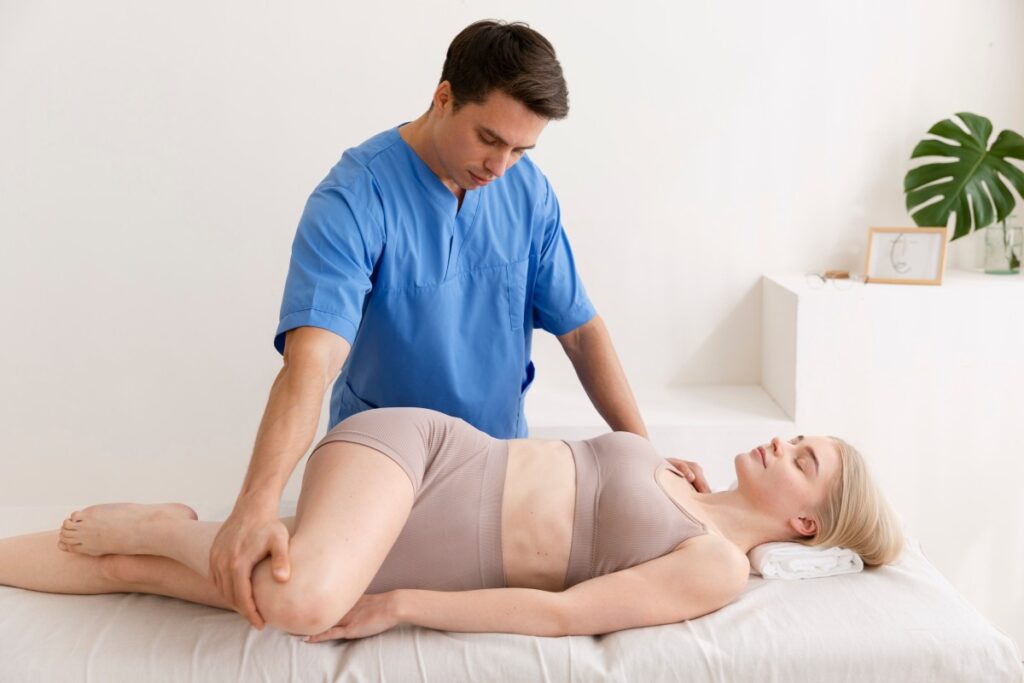
What Is Sciatica? (The Clear, Simple Explanation)
Sciatica is not a diagnosis in itself it’s a symptom. Specifically, it’s pain, tingling, numbness, or weakness that travels along the path of the sciatic nerve the longest and widest nerve in the human body.
The sciatic nerve starts in the lower lumbar spine (L4, L5) and sacral spine (S1, S2, S3), runs through the buttock, travels down the back of the thigh, and branches into the lower leg and foot. When something compresses or irritates this nerve anywhere along that path, you feel it sometimes all the way down to your toes.
Sciatica is not the same as general lower back pain. The defining feature is that the pain travels it radiates out of the spine and into the leg. That radiation is the nerve talking.
According to Healthdirect Australia, sciatica affects a significant proportion of Australians at some point in their lives and it’s one of the most common reasons people search for a chiropractor for sciatica near me across the Logan Southside region.
What Does Sciatica Actually Feel Like?
Sciatica presents differently for different people. The most common descriptions from patients at our Jimboomba chiropractic clinic include:
- A sharp, shooting pain that fires from the lower back into the buttock and down the back of the leg
- A deep, burning sensation in the thigh or calf
- Electric-like jolts of pain sometimes triggered by sitting, standing, coughing, or sneezing
- Numbness or a “dead” feeling in the leg, foot, or toes
- Tingling or pins and needles running down into the foot
- Weakness in the leg difficulty lifting the foot or standing from a seated position
Some patients have constant pain. Others get intense episodes that come and go. Some have pain only on one side; occasionally both legs are affected. The pattern depends on which nerve roots are involved and what’s compressing them.
One thing that is consistent: sciatica that comes back regularly, or that has been present for more than 2–3 weeks, needs professional assessment. Waiting it out is not a strategy it’s a gamble that usually doesn’t pay off.
What Is Actually Causing Sciatica? The 4 Most Common Sources
This is the most important question and the one that most people never get a clear answer to. Understanding the source of your sciatica determines how it’s treated.
1. Disc Herniation or Bulge (Most Common)
The discs between your lumbar vertebrae act as shock absorbers. When a disc bulges or herniates often from prolonged sitting, poor lifting mechanics, or cumulative spinal stress it can press directly onto the nerve roots that form the sciatic nerve.
Disc-related sciatica is typically worse when sitting, improves slightly with walking, and is often triggered by coughing, sneezing, or bending forward. It can come on suddenly one wrong lift, one awkward movement or develop gradually over months of desk work.
This is one of the most common presentations we see from patients in Browns Plains, Park Ridge, and Greenbank areas with a high proportion of office workers and trades people whose daily demands put repeated stress on the lumbar discs.
2. Lumbar Joint Restriction and Nerve Compression
When the facet joints between the lumbar vertebrae become restricted or inflamed, the narrowing of the spinal canal and nerve exit points (foramina) can compress the sciatic nerve roots. This type of sciatica often develops gradually, is associated with lower back stiffness, and is typically worse in the morning and after prolonged sitting.
Chiropractic spinal adjustment is particularly effective for this type of sciatica restoring joint mobility directly relieves the compression that’s driving the nerve irritation.
3. Piriformis Syndrome
The piriformis is a small muscle deep in the buttock that the sciatic nerve runs beneath and in some people, directly through. When this muscle becomes tight, inflamed, or in spasm, it can compress the sciatic nerve at the level of the buttock rather than the spine.
Piriformis-related sciatica presents as deep buttock pain with leg radiation, is often worse after sitting on hard surfaces, and is commonly aggravated by hip rotation. It’s frequently missed or misdiagnosed because the compression point is in the buttock rather than the lumbar spine.
We see this often in Beaudesert patients particularly those in physically active occupations, farmers, and people who spend extended periods driving or on equipment.
4. Sciatica During Pregnancy
Pregnancy is a common trigger for sciatica particularly in the second and third trimesters. The growing uterus shifts the centre of gravity, increases lumbar curvature, and places direct pressure on the sciatic nerve through the expanding pelvis.
The hormone relaxin, which loosens ligaments in preparation for birth, also reduces pelvic stability increasing the load on the surrounding muscles and compressing the sciatic nerve.
Pregnancy sciatica responds very well to chiropractic care. At Jimboomba Chiropractic, we use gentle, pregnancy-adapted techniques including the Webster Technique for pelvic balance that are completely safe at every trimester.
👉 Learn more about pregnancy chiropractic care →
Why Sciatica Gets Worse If You Ignore It
Here’s what happens when sciatica is left untreated and it matters.
In the early stages, the nerve is being irritated but not damaged. Rest, heat, and anti-inflammatories may reduce the immediate pain enough to function. But the underlying compression remains. Every flare-up causes more irritation to the nerve sheath. Over time, the nerve becomes increasingly sensitive and reactive.
Left long enough, chronic sciatic nerve compression can cause:
- Permanent numbness in the leg or foot
- Muscle weakness that doesn’t fully recover
- Drop foot difficulty lifting the front of the foot when walking
- Chronic pain sensitisation where the nervous system becomes hypersensitive and pain persists even after the structural cause is resolved
This is why we tell every patient from Greenbank, Park Ridge, Browns Plains, Beaudesert, and Jimboomba who comes in with leg pain: the right time to treat sciatica is now not after another few months of hoping it improves.
How Chiropractic Treatment at Jimboomba May Help Sciatica Pain
Chiropractic care focuses on improving spinal and joint function while reducing pressure on irritated nerves.
Depending on your condition, treatment may include:
Chiropractic Adjustments
Gentle spinal adjustments may help improve movement and reduce nerve irritation.
Soft Tissue Therapy
Tight muscles around the hips and lower back can contribute to sciatica pain.
Posture Advice
Simple posture changes often reduce pressure on the lower back.
Exercise and Stretching Guidance
Specific movements can help improve flexibility and stability.
Pregnancy Chiropractic Care
A pregnancy chiropractor Jimboomba can help reduce pelvic and lower back stress during pregnancy.
Family Chiropractic Support
Some families also visit a pediatric chiropractor Jimboomba for posture and movement assessments in growing children.
Targeted Spinal Adjustment
For lumbar joint restriction and disc-related sciatica, Dr. Theo uses precise, targeted chiropractic adjustments to the specific spinal segments involved. Restoring normal movement to a restricted L4, L5, or S1 joint directly relieves pressure on the affected nerve root.
Most patients notice a change in their leg symptoms often within the first 2–3 sessions. The leg pain tends to centralise (move back toward the spine) before it resolves a sign the nerve decompression is working.
For patients who prefer a gentler approach, the Activator Method delivers effective spinal mobilisation without manual rotation or force, ideal for patients in acute pain, those with disc involvement, or those who are simply nervous about their first chiropractic visit.
Piriformis and Gluteal Soft Tissue Release
For piriformis-related sciatica and as a complement to spinal adjustment in disc cases, we use targeted deep soft tissue release to the piriformis, gluteus medius, and surrounding hip muscles. Releasing the muscular compression on the sciatic nerve is often as important as the spinal adjustment itself.
Home Exercises and Advice
Between appointments, specific exercises and stretches target the underlying mechanics. We prescribe these individually, not a generic sheet based on your specific presentation. The right exercises accelerate recovery. The wrong ones (many commonly recommended “sciatica stretches” are contraindicated for disc herniation) can set it back.
We also advise on:
- Sitting positions and duration limits
- Safe ways to get in and out of the car (a common sciatica aggravator)
- Sleeping positions to reduce nerve tension overnight
- Work modifications for patients in physically demanding roles
How Long Does Sciatica Take to Fix With Chiropractic?
Honestly it depends on how long it’s been present and what’s causing it.
Acute sciatica (less than 6 weeks, first episode): most patients see significant improvement in 4–8 sessions. The nerve responds quickly when the compression is removed early.
Subacute sciatica (6 weeks to 3 months): typically 8–12 sessions for meaningful improvement. The nerve has had time to become sensitised, so recovery is slightly slower.
Chronic sciatica (3+ months, recurring episodes): longer initial plan required, but chiropractic still produces excellent results. Many patients who have had sciatica for years managing with medication and limited activity experience significant change within the first month of proper treatment.
We give you a realistic, specific estimate at your first appointment. No open-ended commitments. No pressure.
Sciatica Treatment Near Greenbank, Park Ridge, Browns Plains and Beaudesert
If you’ve been putting up with that shooting leg pain and looking for a sciatica chiropractor near me in the Logan Southside area, Jimboomba Chiropractic is your closest trusted option.
From Greenbank: approximately 15–18 minutes via Teviot Road to the Mount Lindesay Highway. From Park Ridge: approximately 18–22 minutes via Park Ridge Road south. From Browns Plains: approximately 20–25 minutes via the Logan Motorway to the Mount Lindesay Highway. From Beaudesert: approximately 25–30 minutes north via the Mount Lindesay Highway.
Free on-site parking. New patients are welcome. No referral required. Same-week appointments are usually available.
FAQ — Sciatica Chiropractor Jimboomba
What is the main cause of sciatica pain?
Sciatica pain is usually caused by pressure or irritation on the sciatic nerve. Common causes include herniated discs, poor posture, pregnancy, and spinal joint problems.
Can a chiropractor help with sciatica?
A chiropractor may help reduce pressure on the sciatic nerve through spinal adjustments, posture advice, and mobility-focused care.
How long does sciatica take to heal?
Mild cases may improve within weeks. Chronic or severe sciatica can last longer without proper treatment.
Is walking good for sciatica pain?
Gentle walking often helps reduce stiffness and improves circulation. However, severe pain should be assessed professionally.
When should I see a chiropractor for sciatica?
You should seek help if pain lasts more than a few days, keeps returning, or affects walking, sleeping, or daily activities.